
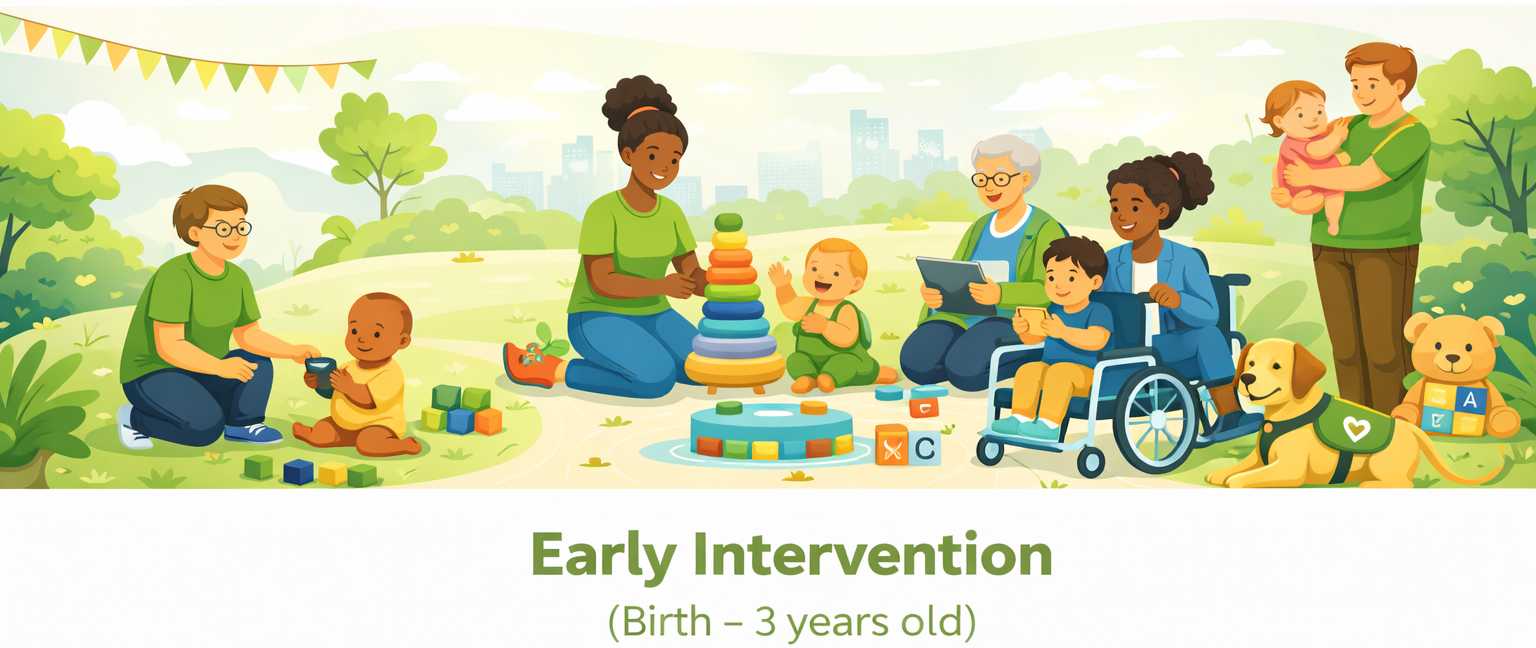
Early intervention (EI) helps young children work toward meeting developmental milestones. While EI is typically until age 3, some are able to extend to age 5. Covered under the Individuals with Disabilities Education Act (IDEA), EI services also are able to support the families who care for the children who are eligible for EI. Early Intervention focuses on skills in five areas: physical (crawling, drawing), cognitive (thinking, learning), communication (talking, listening, understanding others), self-help or adaptive (eating, dressing), social or emotional (playing, interacting with others). Services can be provided at home or in the community and depending on which skills are delayed, there are different types of specialists who work with the children.
It is never too early to start thinking about employment. At this stage, focus on the positives and the strengths of the child noticed at such a young age.
- Does the child’s smile light up a room?
- Do people naturally gravitate towards the child because of their personality?
- How do they communicate with you and with others?
- What CAN the child do, with or without assistive technology or other supports?
- Who or what makes your child happy?
Early InterventionFAQs
To be eligible, your child ages birth to 3 must have either:
- A developmental delay, OR
- A specific health condition that will probably lead to a delay. This includes things like hearing loss, birth defects, and certain genetic disorders.